
4-Year-Old Milestones: Development & Memory Ideas
The CDC's 4 year old milestones, how preschoolers develop, activities that help and memory ideas for age four.

Four-year-olds are storytellers, helpers and big negotiators. They invent games with friends, ask you what a word means and then use it at dinner, and draw people with arms sticking out of their heads. This guide covers the 4-year-old milestones the CDC tracks, what development looks like this year, activities that help, and memory ideas to capture this chatty, imaginative age.
Quick answer
The CDC’s 4-year-old milestones include pretend play, comforting others, liking to be a “helper,” speaking in sentences of four or more words, talking about their day and answering simple questions. Most 4-year-olds also name a few colors, tell what comes next in a familiar story, draw a person with three or more body parts, catch a large ball, pour water with supervision and hold a crayon between fingers and thumb.
Key takeaways
- CDC milestones describe what most children (75% or more) can do by 48 months.
- Imagination, friendship and empathy grow quickly at four.
- Pencil grip and drawing show fine motor skills preparing for writing.
- The AAP recommends developmental checks at every well visit, including the 4-year checkup.
4-year-old milestones checklist (CDC)
Social and emotional
- Pretends to be something else during play (teacher, superhero, dog).
- Asks to go play with children if none are around.
- Comforts others who are hurt or sad, like hugging a crying friend.
- Avoids danger, like not jumping from tall heights at the playground.
- Likes to be a “helper.”
- Changes behavior based on where they are, like a library or playground.
Language and communication
- Says sentences with four or more words.
- Says some words from a song, story or nursery rhyme.
- Talks about at least one thing that happened during the day.
- Answers simple questions like “What is a coat for?”
Cognitive (learning and problem-solving)
- Names a few colors of items.
- Tells what comes next in a well-known story.
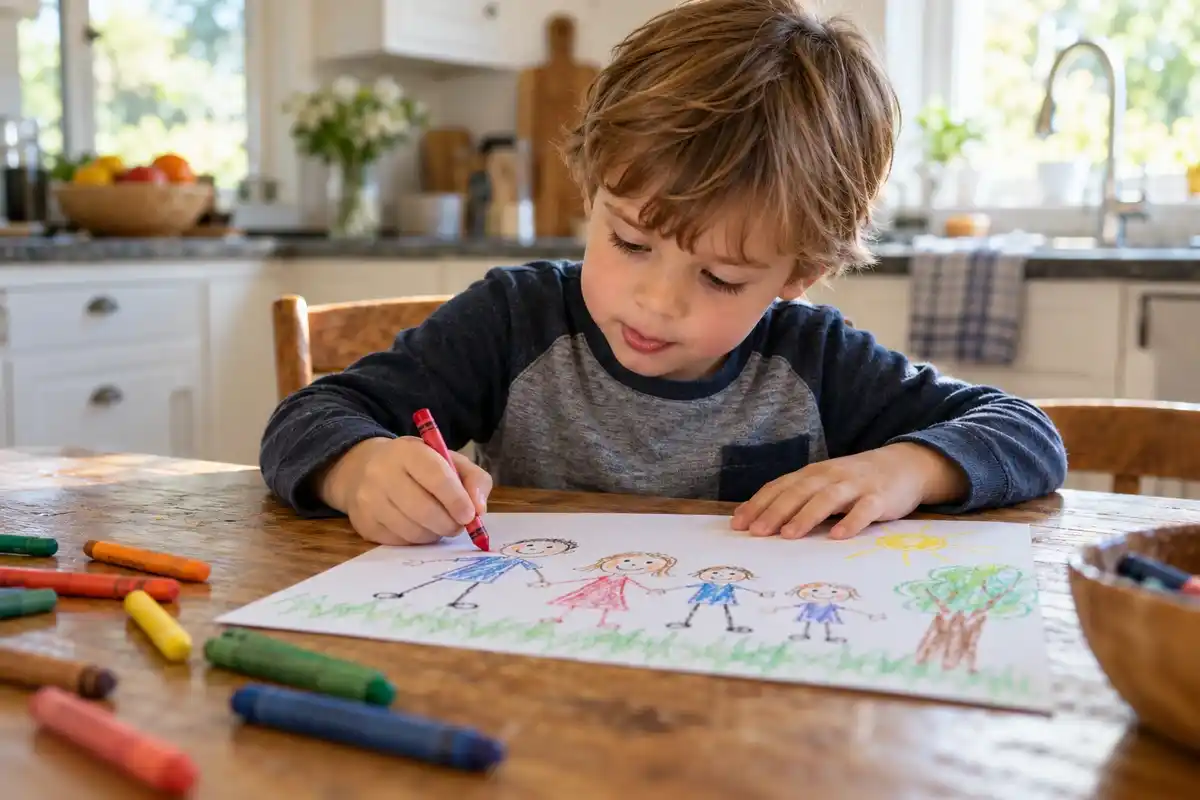
- Draws a person with three or more body parts.
Movement and physical
- Catches a large ball most of the time.
- Serves themselves food or pours water, with adult supervision.
- Unbuttons some buttons.
- Holds a crayon or pencil between fingers and thumb (not a fist).
Most 4-year-olds have also reached the 3-year-old milestones, like holding conversations and using a fork.
How 4-year-olds develop
Language: the little storyteller
Four-year-olds use longer sentences, tell stories with a beginning and an end (mostly), and love silly words and rhymes. They ask “why” and “how” constantly and may start to understand simple jokes.
Social: real friendships
Play becomes cooperative. They make up rules, assign roles (“You be the dog!”) and start to name a best friend. Taking turns improves, although conflicts are still common and are a chance to practice solving problems.
Emotional: big feelings, more words
They can name more feelings and show real empathy. Still, frustration, fears (the dark, monsters) and testing limits are normal. Calm routines and clear, simple rules help.
Physical: stronger and more coordinated
Many 4-year-olds hop on one foot, climb confidently, pedal a tricycle and start to use child-safe scissors. Fine motor skills, like buttoning and drawing, prepare them for writing.
Their stories won’t sound like this for long. Childhood Milestones lets you record your 4-year-old’s stories and questions as voice notes and save each first with the date.
Activities that support 4-year-old development
- Story dice or picture cards. Take turns adding a sentence to a silly story.
- Dress-up and pretend play. A box of old clothes builds language and imagination.
- Draw-a-person game. Ask them to draw your family, then tell you about it.
- Ball games. Catching, kicking and rolling games build coordination.
- Kitchen helper jobs. Pouring, stirring and setting the table feed their love of helping.
- Rhymes and songs. Clapping games build early literacy. For more ideas, see activities for kids by age and indoor activities for kids.
Healthy habits matter, too. The American Academy of Sleep Medicine recommends 10 to 13 hours of sleep per 24 hours, including naps, for children 3 to 5, and the AAP suggests limiting screen time to about 1 hour a day of high-quality content for ages 2 to 5.
When to talk to your pediatrician
Every child develops at their own pace, but the CDC encourages parents to act early. Talk to your child’s doctor if, around age 4, your child:
- Doesn’t speak in sentences or is hard for strangers to understand.
- Doesn’t play pretend or show interest in other children.
- Can’t follow simple instructions or answer simple questions.
- Has trouble with scribbling, stairs or catching a ball.
- Loses skills they used to have.
Your local public school district can also arrange a free evaluation for children 3 and older.
This guide is for general information and doesn’t replace advice from your pediatrician.
Memory ideas for age four

- Birthday interview. Ask the same questions every year: favorite food, best friend, what they want to be. Find ideas in our questions to ask kids.
- Save a self-portrait. Date it and compare with next year’s.
- Record a story they tell. Their grammar, their logic and their voice at four are priceless.
- Write down funny quotes. Keep a running list on your phone.
- Handprint and height. Same page, same door frame, every birthday.
Age four, remembered
Stories, drawings and firsts in one place
Childhood Milestones saves your child’s firsts, suggests activities for their age and keeps voice notes, videos and photos of their artwork on a private family timeline.
Sources
This guide summarizes public guidance from the CDC and the American Academy of Pediatrics (AAP). The milestone lists come from these sources; the activity and memory ideas are our own suggestions. This article has not been reviewed by a clinician and doesn’t replace your pediatrician’s advice. Last reviewed: November 1, 2026.
Frequently asked questions
What should a 4-year-old be able to do?
Most 4-year-olds play pretend, comfort friends, speak in sentences of four or more words, talk about their day, name some colors, draw a person with three or more body parts, catch a large ball and hold a crayon with their fingers.
Should a 4-year-old know letters and numbers?
Many 4-year-olds recognize some letters and count to 10 or more, but there’s a wide range. Reading together and playful counting help more than drills.
How many words should a 4-year-old say in a sentence?
The CDC milestone is sentences with four or more words. Many 4-year-olds speak in much longer sentences and tell simple stories.
How much sleep does a 4-year-old need?
The American Academy of Sleep Medicine recommends 10 to 13 hours in 24 hours, including naps, for children 3 to 5 years old.

When Do Babies Walk? First Steps Guide
When babies walk, the stages before first steps, how to help, why to skip walkers and when to talk to your pediatrician.

3-Year-Old Milestones: A Parent’s Checklist
The CDC's 3 year old milestones checklist: talking, play, movement and self-care, how to support your preschooler and when to check in.

18-Month Milestones: What to Expect and What to Record
The CDC's 18 month milestones, words and behavior, the 18-month checkup and what to record at a year and a half.
Eighteen years go faster than you think. Start saving their story today.
Discover meaningful things to do together, capture the milestones that matter and keep photos, stories and voice memories on one beautiful timeline — from birth to 18.