
When Do Babies Crawl? Stages, Signs & How to Capture It
When do babies crawl? Most start between 7 and 10 months. Learn the stages, crawling styles, signs, tips to help, baby-proofing and how to capture the first crawl.
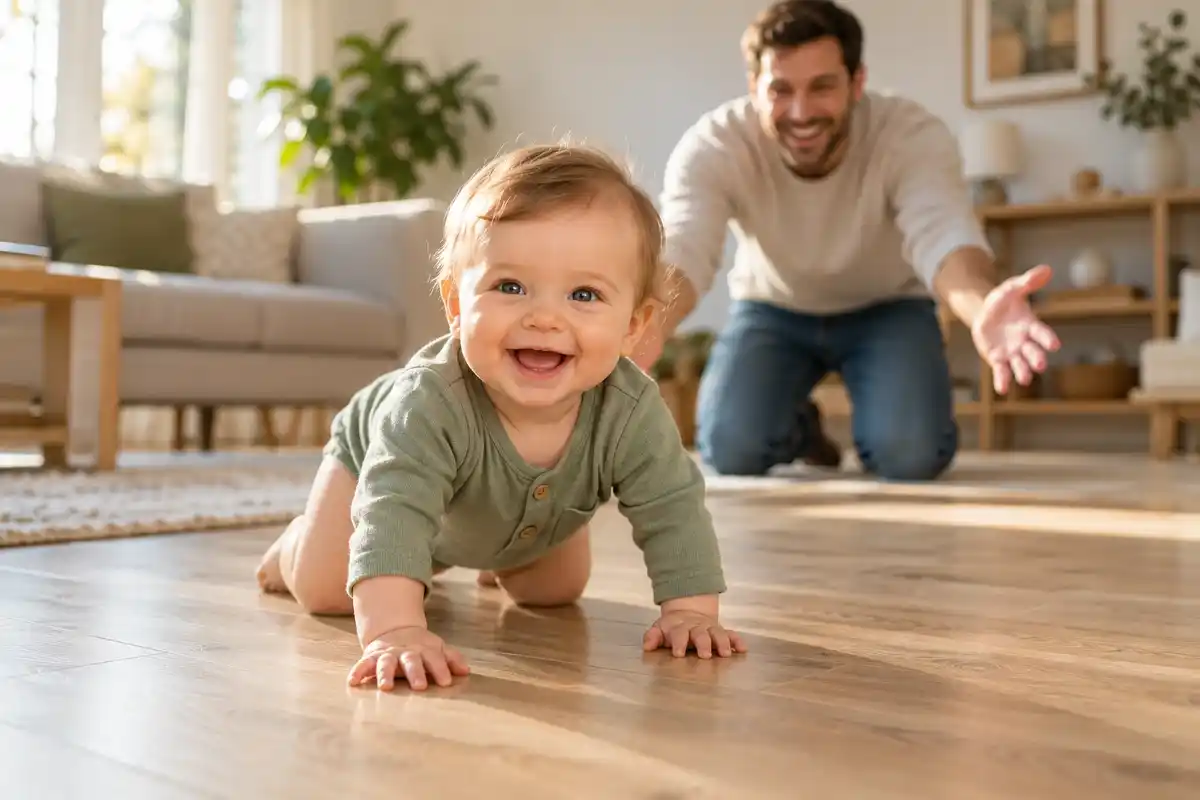
First they roll, then they sit, and one day you turn around and your baby is halfway across the living room. Crawling is a huge leap in independence, for your baby and for your baby-proofing. Here’s when babies crawl, the stages and styles to expect, how to encourage it, and how to capture that first wobbly trip across the floor.
Quick answer
When do babies crawl? Most babies start crawling between 7 and 10 months, and some not until 12 months. Many begin with a belly crawl or scoot before crawling on hands and knees. Some babies skip crawling entirely and go straight to pulling up and walking, which is why the CDC no longer lists crawling as an official milestone.
Key takeaways
- The usual range is 7 to 10 months, but anywhere from 6 to 12 months can be normal.
- Rocking on hands and knees is the classic sign crawling is close.
- Every style counts: army crawl, scooting and bear crawl all build strength.
- Baby-proof before the first crawl, not after.
- What matters most is that your baby is finding a way to move and using both sides of the body.
When do babies crawl? The typical age range
Most babies crawl between 7 and 10 months. Cleveland Clinic and Lurie Children’s Hospital both describe a wide normal range, with some babies starting around 6 months and others closer to their first birthday. If your baby was born early, count from their due date (their adjusted age).
In 2022, the CDC updated its milestone checklists to show what 75% or more of babies can do at each age. Crawling was removed because not enough babies do it. That doesn’t mean crawling isn’t valuable. It means there’s more than one healthy path to walking.
The stages of crawling
Crawling is built step by step on skills your baby practiced for months:
- Tummy time and pushing up (2–6 months). Lifting the head, then pushing up on forearms and later straight arms, builds shoulder and neck strength.
- Rolling (4–6 months). Many babies first get places by rolling. See our guide on when babies roll over.
- Sitting and pivoting (6–9 months). Sitting without support and turning on their tummy to reach toys strengthen the core.
- Rocking on hands and knees (6–9 months). Babies get into “all fours” and rock back and forth, testing their balance.
- First crawl (7–10 months). Often backward first, since arms are stronger than legs. Forward movement follows.
- Confident crawling (9–12 months). Faster, over cushions and toward stairs, usually alongside pulling up to stand.
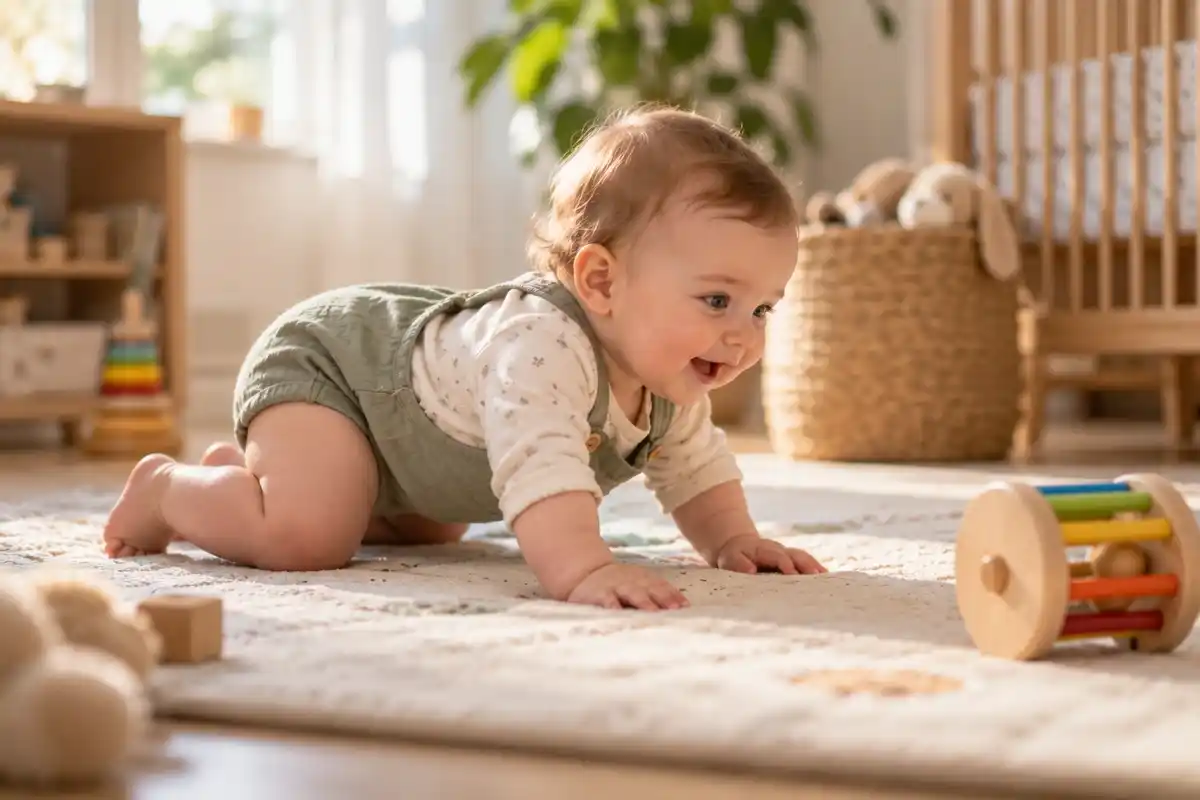
Types of crawling (they all count)
- Classic crawl: hands and knees, opposite arm and leg moving together.
- Army or commando crawl: belly on the floor, pulling forward with the forearms.
- Bear crawl: hands and feet, arms and legs straight, bottom in the air.
- Bottom scoot: sitting up and shuffling forward with the arms and legs.
- Crab crawl: moving backward or sideways, often the very first attempt.
- Rolling: some babies simply roll wherever they want to go.
Many babies mix styles before settling on one. The style matters less than the fact that your baby is moving, exploring and using both sides of the body.
Signs your baby will crawl soon
- Pushes up on straight arms and lifts the chest high during tummy time.
- Sits steadily without support and gets out of sitting onto the tummy.
- Gets up on hands and knees and rocks.
- Pivots in circles on the tummy to reach toys.
- Scoots backward, often to their own frustration.
How to help your baby crawl: 7 tips
- Keep up tummy time. The AAP recommends starting in the first days home and building to 15 to 30 minutes a day by about 7 weeks. Older babies benefit from plenty more floor play.
- Put toys just out of reach. A favorite ball or rattle a short distance away gives them a reason to move.
- Get on the floor. Lie a few feet away and call them. You’re the best motivation there is.
- Build a gentle obstacle course. Pillows and a folded blanket to crawl over build strength and coordination.
- Support their feet. When they’re rocking on all fours, place your hands behind their feet so they have something to push against.
- Limit “container” time. Bouncers, swings and car seats are useful, but crawling is learned on the floor.
- Dress for grip. Bare feet and soft pants help on hard floors; bare knees can slip or scrape.
Don’t let the first crawl become a blur. Childhood Milestones saves every first with the date, a video and a note, and suggests activities for your baby’s exact age.
Baby-proofing checklist before your baby crawls
Crawling babies move fast and put everything in their mouths. Get down at their eye level and look for:
- Furniture and TVs: anchor dressers, bookcases and TVs to the wall so they can’t tip over.
- Stairs: install safety gates at the top and bottom.
- Outlets and cords: use outlet covers and keep electrical and window blind cords out of reach.
- Small objects: if something fits through a toilet paper tube, it’s a choking hazard. Watch for coins, button batteries and magnets.
- Cabinets: lock up cleaning products, medicines and laundry pods.
- Sharp corners and hot things: pad table edges and block access to fireplaces, heaters and oven doors.
When to talk to your pediatrician
A baby who isn’t crawling isn’t automatically a concern, especially if they are rolling, sitting and trying to move in other ways. Mention it to your pediatrician if your baby:
- Shows no interest in moving or getting to toys by around 10 months.
- Isn’t sitting without support or getting into a sitting position by 9 months (a CDC milestone).
- Consistently drags one arm or leg, or uses one side of the body much more than the other.
- Feels very stiff or very floppy, or doesn’t bear weight on their legs when held upright.
- Loses a skill they already had.
You can also contact your state’s early intervention program for a free evaluation. Trust your instincts: asking early is always okay.
This article is for general information and doesn’t replace advice from your pediatrician.
How to capture your baby’s first crawl
The first crawl rarely happens on cue, so be ready:
- Film at floor level. Get down to your baby’s height and turn your phone sideways. It looks like a movie, not a security camera.
- Record the “before.” Save a clip of the rocking and backward scooting. Later, you’ll love seeing how hard they worked.
- Write down the details: the date, their age in weeks, their crawling style and what they were crawling toward.
- Add a line about you. How it felt to watch is a memory worth keeping too.

From first crawl to first steps
Keep every first in one beautiful timeline
Save the video, the date and a note in seconds. Childhood Milestones turns your baby’s firsts into a story you can share with family and look back on for years.
Frequently asked questions
What is the earliest age a baby can crawl?
Some babies start crawling around 6 months, especially those who spent lots of time on their tummy. Most crawl between 7 and 10 months.
Is it okay if my baby skips crawling?
Yes, often. Some babies scoot, roll or go straight to pulling up and walking. If your baby is meeting other milestones, like sitting and pulling up, skipping crawling usually isn’t a concern.
Why does my baby crawl backward?
Babies’ arms are usually stronger than their legs at first, so pushing moves them backward. Forward crawling typically follows within a few weeks.
How long after crawling do babies walk?
It varies a lot, but many babies take their first independent steps a few months after crawling, often between 9 and 18 months.

Baby Milestones: Month-by-Month Guide (0–12 Months) + Free Tracker
Baby milestones month by month from 0 to 12 months, based on the CDC checklists: social, language, thinking and movement skills, plus…

250 Would You Rather Questions for Kids
Would you rather questions for kids sorted by theme and age, from silly and superpower questions to easy picks for toddlers, plus…

When Do Babies Roll Over? Timeline + Tips
When do babies roll over? Most babies roll between 4 and 6 months. Here's the timeline, signs to watch for, tips to…
Eighteen years go faster than you think. Start saving their story today.
Discover meaningful things to do together, capture the milestones that matter and keep photos, stories and voice memories on one beautiful timeline — from birth to 18.