
Letter to My Daughter or Son: How to Write One (+ Examples)
How to write a letter to your daughter or son they’ll keep forever: 12 prompts, step-by-step tips and heartfelt examples, from newborn to 18th birthday.
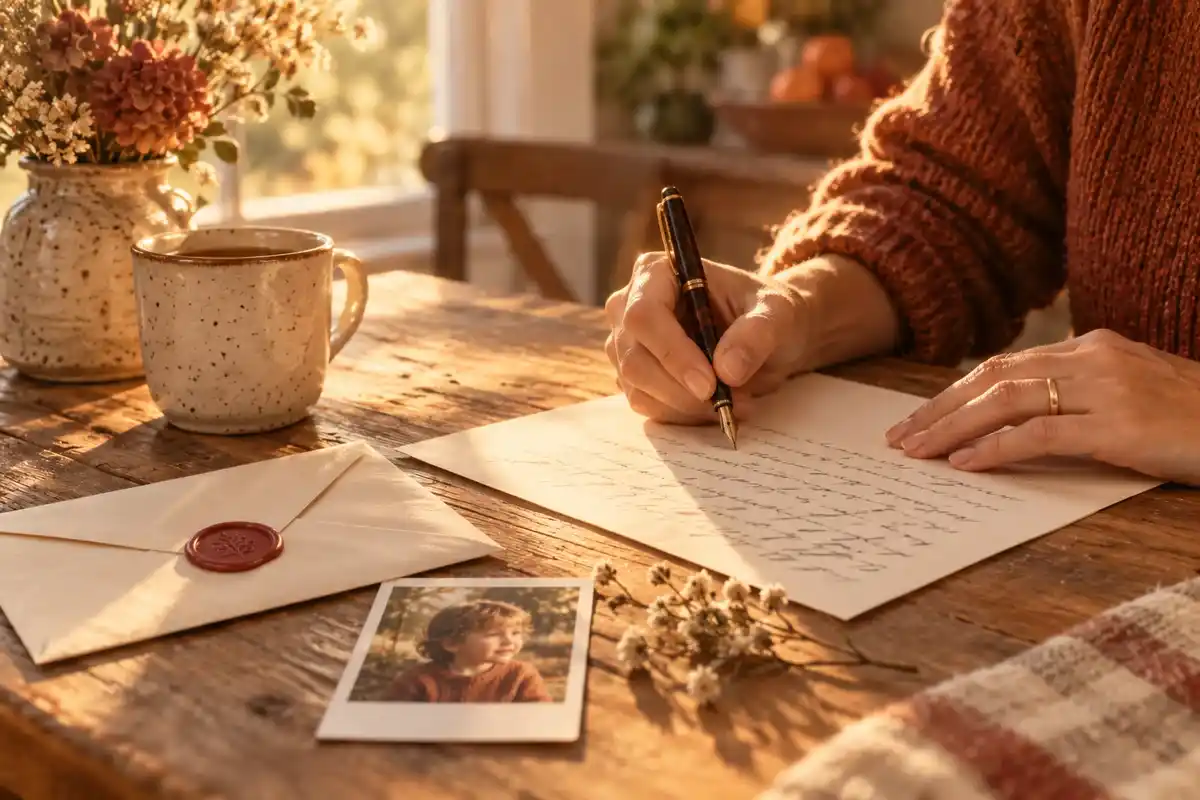
Someday your child will be an adult reading words you wrote when they were small. A letter to your daughter or son is one of the simplest things you can make as a parent — and one of the few that becomes more valuable every single year. This guide shows you exactly what to write, when to write it, and how to keep it safe until the right moment, with real examples you can adapt tonight.
Quick answer
To write a letter to your daughter or son: (1) pick a moment or age they’ll read it, (2) describe who they are right now in specific details, (3) share a memory only you hold, (4) tell them what you admire and hope for them, and (5) end with unconditional love. Date it, keep it somewhere safe, and consider recording yourself reading it — your voice is part of the gift.
Key takeaways
- Specific details (“you sing to your cereal”) matter more than perfect writing.
- Great moments to write: birthdays, the first day of school, big transitions, their 18th birthday — or any ordinary Tuesday.
- Write to the person they’ll become, not just the child in front of you.
- Protect it: keep a paper copy and a digital backup, or seal it in a time capsule.
Why a letter to your daughter or son matters
Photos capture what your child looked like. A letter captures what it felt like to be their parent — the private, everyday details nobody else noticed. Years from now, those details answer questions your child may never think to ask out loud: Who was I when I was little? Was I loved the way I hoped? What did my parents see in me?
There is science behind it, too. Researchers at UC Berkeley’s Greater Good Science Center found that writing a gratitude letter can boost happiness for the writer as well as the reader — so writing a letter to your daughter or son is a gift that works both ways.
Letters also do something for you. Putting your love into words forces you to slow down and notice the child in front of you: the way she narrates her games, the way he insists on wearing mismatched socks. Many parents say writing their first letter was the moment they finally felt present in a busy season.
When to write a letter to your daughter or son
There is no wrong time — but some moments naturally invite a letter:
- Before birth or in the newborn weeks. Describe the waiting, the first meeting, the sleepless nights.
- Every birthday. An annual letter becomes a year-by-year portrait. It’s the easiest habit to keep because the date reminds you.
- First day of school, first sleepover, first job. Transitions are when both of you are growing.
- Hard seasons. A move, an illness in the family, a loss. Letters written in hard times often become the most treasured.
- Their 18th birthday or graduation. The classic “open when you’re grown” letter, often sealed years in advance.
- A random Tuesday. Sometimes the most meaningful letters are about nothing special at all.
What to write in a letter to your child: 12 prompts
If you’re staring at a blank page, answer three or four of these. You don’t need them all.
- Right now, you are… (age, height, the things you say, what you’re obsessed with).
- A normal day with you looks like…
- The funniest thing you did or said recently was…
- Something you don’t know I noticed about you is…
- When you were born / when you came into our family, I felt…
- A memory with you I never want to forget is…
- I am proud of you for… (focus on character, not achievements).
- Something I learned from you is…
- What’s happening in the world and in our family right now…
- My hope for you is… (keep it about who they are, not what they do).
- When life gets hard, I want you to remember…
- No matter what, I will always…
Write it once. Deliver it at the perfect moment. Time capsule messages in Childhood Milestones stay sealed until the date you choose — like their 18th birthday.
How to write a letter to your daughter or son, step by step
1. Decide who you’re writing to
Are you writing to your five-year-old, to be read aloud this weekend? Or to your future 18-year-old, to be opened years from now? The answer shapes your tone. For future letters, write to the adult they’ll be, while describing the child they are.
2. Start with a specific snapshot
Open with a scene instead of a statement. “You’re asleep in the next room with one sock on and your dinosaur under your chin” pulls the reader in more than “I love you so much.”
3. Add a memory only you have
Your child can’t remember being two, or what they said the first time they saw the ocean. You can. These memories are the heart of the letter.
4. Name what you admire
Kids (and adults) remember praise for who they are: kind, curious, brave, funny, stubborn in the best way. Give examples.
5. Share hopes, not expectations
“I hope you always find people who make you laugh like your cousin does” lands better than “I hope you become a doctor.” Leave room for them to be themselves.
6. Close with unconditional love
End with something they can hold onto on hard days: there is nothing they could do to make you love them less.
7. Date it and sign it
Include the date, their age and where you were. Future readers treasure context.
Letter examples for your daughter or son
Use these as inspiration, not scripts. The more of your own details you add, the better.
Letter to my daughter (from Mom, age 4)
My sweet Mia,
You are four years and two months old, and right now you are convinced the moon follows our car because it wants to come home with us. Every morning, you sing to your cereal. And you call spaghetti “pasketti” and I secretly hope you never stop.
Yesterday you saw a boy crying at the park and walked over to give him your favorite leaf. Not a word — you just handed it to him. That’s who you are: someone who notices.
I don’t know who you’ll be when you read this. But I know that the girl who shares her favorite leaf is in there somewhere, and I hope you keep her close. I love you more than all the leaves in the world.
Love always, Mom
First day of school: a letter to my son (from Dad)
Leo,
Today you walked into kindergarten with a backpack almost as big as you. At the door, you turned around once, gave me a thumbs-up, and kept going. I stood at the gate a little longer than the other parents.
You are brave in a quiet way. Every day, you ask a hundred questions about how things work, and you never let me give you a lazy answer. I hope school gives you a hundred more questions.
Whatever happens in there — good days and hard ones — I’ll be at the gate at three o’clock. That part never changes.
Proud of you, Dad
For his 18th birthday: a letter to my son (from Mom)
Dear Sam,
Eighteen. I wrote the first letter to you when you were two weeks old and I was too tired to spell. Somewhere between then and now you learned to ride a bike, fell in love with music, broke your arm, fixed our dishwasher and taught me more patience than I thought I had.
The world will tell you that being a man means having all the answers. It doesn’t. It means being honest when you don’t, and kind anyway. Luckily, you already know how to do that — I’ve watched you do it with your little sister for years.
Go be wonderfully yourself. Call your mother. And know that home is always here.
All my love, Mom
Letter to my newborn daughter (from Dad)
Hi, little one.
You are nine days old. Right now, you smell like milk and sunshine and you only fall asleep if I hum the same off-key song. Your mom says you have my eyebrows; I think you have her stubbornness already.
I promise to show up — to school plays and scraped knees and the conversations that get harder as you get older. And I promise to listen more than I lecture. I will get a lot of things wrong, but loving you will never be one of them.
Welcome to the world, Dad
Short letter ideas for any occasion
Not every letter needs to be long. These openings work well for quick notes you can tuck into a lunchbox, a birthday card or a time capsule:
- Birthday: “This year you learned to… and I watched you become…”
- Before a big game or recital: “Win or lose, the part I love most is watching how hard you try.”
- After a tough day: “You don’t have to be okay today. You just have to know I’m here.”
- Graduation: “I remember when your backpack was bigger than you. Look at you now.”
- Just because: “I was thinking about the way you laugh at your own jokes, and it made my whole day.”
How to keep your letters safe until the right moment
A letter only matters if it survives long enough to be read. Here are a few options:
- A sealed envelope in a keepsake box. Write “Open on your 18th birthday” on the front. Use acid-free paper if you can.
- A family time capsule. Add your letter, a photo, a drawing and a small object from this year. (See our family traditions ideas for a yearly time-capsule ritual.)
- A digital copy. Paper gets lost in moves and floods. Photograph or type your letter and back it up.
- A voice recording. Read your letter out loud and record it. Hearing a parent’s voice — at a certain age — can mean more than the words.
- A dedicated app. In Childhood Milestones, time capsule messages stay locked until the date you choose, and voice memories live on your child’s timeline next to the photos from that year.
Time capsule messages
Seal a letter today. Let it open on their 18th birthday.
Write or record a message, choose the opening date, and let it wait safely — alongside the photos, stories and voice memories of the years in between.
Mistakes to avoid when writing to your child
- Waiting for the perfect words. A short, honest letter beats the perfect one you never write.
- Making it about expectations. Avoid “I expect you to…” — it can feel heavy to read later.
- Only mentioning achievements. Grades and trophies fade; character and small moments last.
- Venting adult worries. It’s okay to be honest about hard times, but keep the letter a safe place for them.
- Not dating it. Without a date and age, future readers lose the context that makes it precious.
- Storing it in only one place. Keep a backup.
Want more ideas for capturing this season? Try our list of 100+ questions to ask kids — their answers make perfect material for your next letter — and our guide on what to write in a baby book.
Frequently asked questions
What should I write in a letter to my daughter?
Describe who she is right now with specific details, share a memory only you hold, tell her what you admire about her character, share your hopes for her, and close with unconditional love. Add the date and her age.
How long should a letter to my son be?
There’s no rule. A half-page letter full of specific details often means more than several pages of general advice. Many parents write 200–500 words.
When should I give my child a letter?
Common moments are birthdays, the first day of school, graduation and the 18th birthday. You can also read short letters aloud to young children, or seal them to be opened at a future milestone.
What is a time capsule letter?
A time capsule letter is written now to be opened at a specific future date — for example, your child’s 18th birthday. It usually describes the present moment in detail and shares your hopes for their future.

What to Write in a Baby Book: Page-by-Page Ideas & Prompts
What to write in a baby book, page by page: birth story, month-by-month prompts, baby’s firsts, letters and a guilt-free way to…

Family Traditions: 60 Ideas to Start This Year
60 family traditions ideas to start this year: weekly rituals, birthday and holiday traditions, milestone moments and free ideas, plus how to…

100+ Questions to Ask Kids (By Age): Fun, Deep & Everyday
Fun, deep and everyday questions to ask kids, organized by age from toddlers to teens, plus tips to get real answers and…
Eighteen years go faster than you think. Start saving their story today.
Discover meaningful things to do together, capture the milestones that matter and keep photos, stories and voice memories on one beautiful timeline — from birth to 18.